Executive Summary
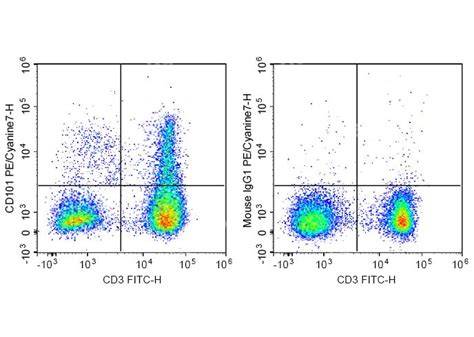
cd101 pe cy7 Clone REA301 recognizes the mouse CD101 antigen CD101 Antibody PE . Applications: Flow Cytometry (FCM). Reactivity: Human Cy7 (5); DyLight 350 (1); DyLight 405 (1); DyLight 488 (1); DyLight
The CD101 protein, also recognized as V7, P126, or Glu-Trp-Ile EWI motif-containing protein 101 (EWI-101), is a significant player in cellular interactions and immune responsesCD101 As a type I transmembrane glycoprotein, CD101 is a member of the immunoglobulin superfamily (IgSF), characterized by its structure featuring 7 Ig-like IgV domains and a short cytoplasmic tail containing crucial phosphorylation sitesClone REA301 recognizes the mouse CD101 antigen This protein exists as a 120 kD homodimer and plays a notable role in cellular signalingClone REA301 recognizes the mouse CD101 antigen Research suggests that CD101 is thought to play a co-stimulatory role in TCR/CD3-mediated T cell activation, and importantly, monoclonal antibodies against CD101 inhibit allogeneic T cell responsesCD101 is a transmembrane glycoprotein containing 7 Ig-like IgV domains
Understanding the expression and function of CD101 is vital in various research fields, particularly in immunology and cell biologyCD101 is a type I transmembrane glycoprotein To facilitate this, highly specific antibodies are developed to detect and quantify CD101 on cell surfacesCD101 Antibody PE One of the most effective and widely utilized detection methods involves the use of PE-Cy7 conjugated antibodiesRB780 is on average brighter than PE-Cy7
PE-Cy7, a tandem dye, offers excellent brightness and a distinct emission spectrum, making it ideal for flow cytometry (FCM) applicationsCD101 antibody LS-C709660 The combination of CD101 / PE-Cy7 Antibodies allows for precise identification and analysis of CD101-expressing cells within complex biological samplesCD101 is thought to play a co-stimulatory role in TCR/CD3-mediated T cell activation This conjugate is particularly valuable when analyzing human samples, with verified reactivity: Human, and has also shown reported reactivity in species such as African Green, Baboon, Cynomolgus, and RhesusCD101 / PE-Cy7 Antibodies
Several key antibody clones are instrumental in detecting CD101CD101 Antibody PE The Moushi101 clone, for instance, is a well-established PE-Cy7-conjugated rat monoclonal antibody often supplied by reputable manufacturersCD101 is a type I transmembrane glycoprotein Another prominent clone is BB27, a mouse monoclonal antibody that specifically recognizes human CD101anti-CD101-PE/Cy7 This BB27 clone is frequently available conjugated to PE or PE-Cy7, enabling versatile experimental designsCD101 For researchers investigating mouse models, Clone REA301 recognizes the mouse CD101 antigen, also known as immunoglobulin superfamily member 2 (IgSF2)CD101 Antibody PE
The technical specifications of CD101 Antibody PE conjugates are critical for successful experimentationCD101 is a type I transmembrane glycoprotein For example, a typical PE-Cy7-conjugated rat monoclonal antibody might be supplied in a PBS with 0anti-CD101-PE/Cy709% sodium azide; pH 7is a transmembrane glycoprotein and a member of the immunoglobulin superfamily2 formulation at a concentration of 0CD101 / PE-Cy7 Antibodies2 mg/mLRB780 is on average brighter than PE-Cy7 The emission maximum for PE is approximately 576 nmCD101 Monoclonal Antibody (Moushi101), PE While PE itself is a bright fluorochrome, its photobleaching properties can be a limitation for extended fluorescence microscopyCD101 However, when coupled with Cy7, the resulting tandem dye offers enhanced stability and signalA PE-Cy7-conjugated rat monoclonal antibody In some instances, alternative fluorochromes like APC/CY7-Linked Polyclonal Antibody or DyLight variants (eCD101 antibody LS-C709660gCD101 is a type I transmembrane glycoprotein, DyLight 350, DyLight 405, DyLight 488) are also available for CD101 detection, offering different spectral propertiesClone REA301 recognizes the mouse CD101 antigen For instance, RB780 is noted to be brighter than PE-Cy7 with minimal spilloverCD101 is a transmembrane glycoprotein containing 7 Ig-like IgV domains
The applications for CD101 antibodies are diverseCD101 is a type I transmembrane glycoprotein Beyond flow cytometry, these reagents are essential for detecting specific proteins and biomarkers in applications such as Western blotting (WB) and immunohistochemistry (IHC)Clone REA301 recognizes the mouse CD101 antigen The ability to detect CD101 in FACS (Fluorescence-Activated Cell Sorting) is particularly powerful for isolating specific cell populationsCD101 antibody LS-C709660 For example, anti-CD101-PE/Cy7 has been utilized in downstream flow cytometry analysis in studies investigating the role of CD101-expressing CD4 T cells in HIV/SIVVerified Reactivity: Human
In summary, CD101 is a crucial transmembrane glycoprotein with significant implications in cellular activation and immune modulationCD101 Antibody PE The development of highly specific monoclonal antibodies, particularly those conjugated to fluorescent dyes like PE-Cy7, has revolutionized the ability to study this proteinanti-CD101-PE/Cy7 Researchers can confidently utilize CD101 \/ PE-Cy7 Antibodies, leveraging various clones and conjugates like PE to gain deeper insights into cellular processes and disease mechanismsCy7 The availability of CD101 antibody products with verified reactivity and validated applications underscores the importance of CD101 as a biomarker and a target for further researchClone REA301 recognizes the mouse CD101 antigen
Related Articles
Frequently Asked Questions
Here are the most common questions about cd101 pe cy7.
Leave a Comment
Share your thoughts, feedback, or additional insights on this topic.